 (704) 361-8609
 Contact Us
Why Cost Per Click Matters in Digital Marketing
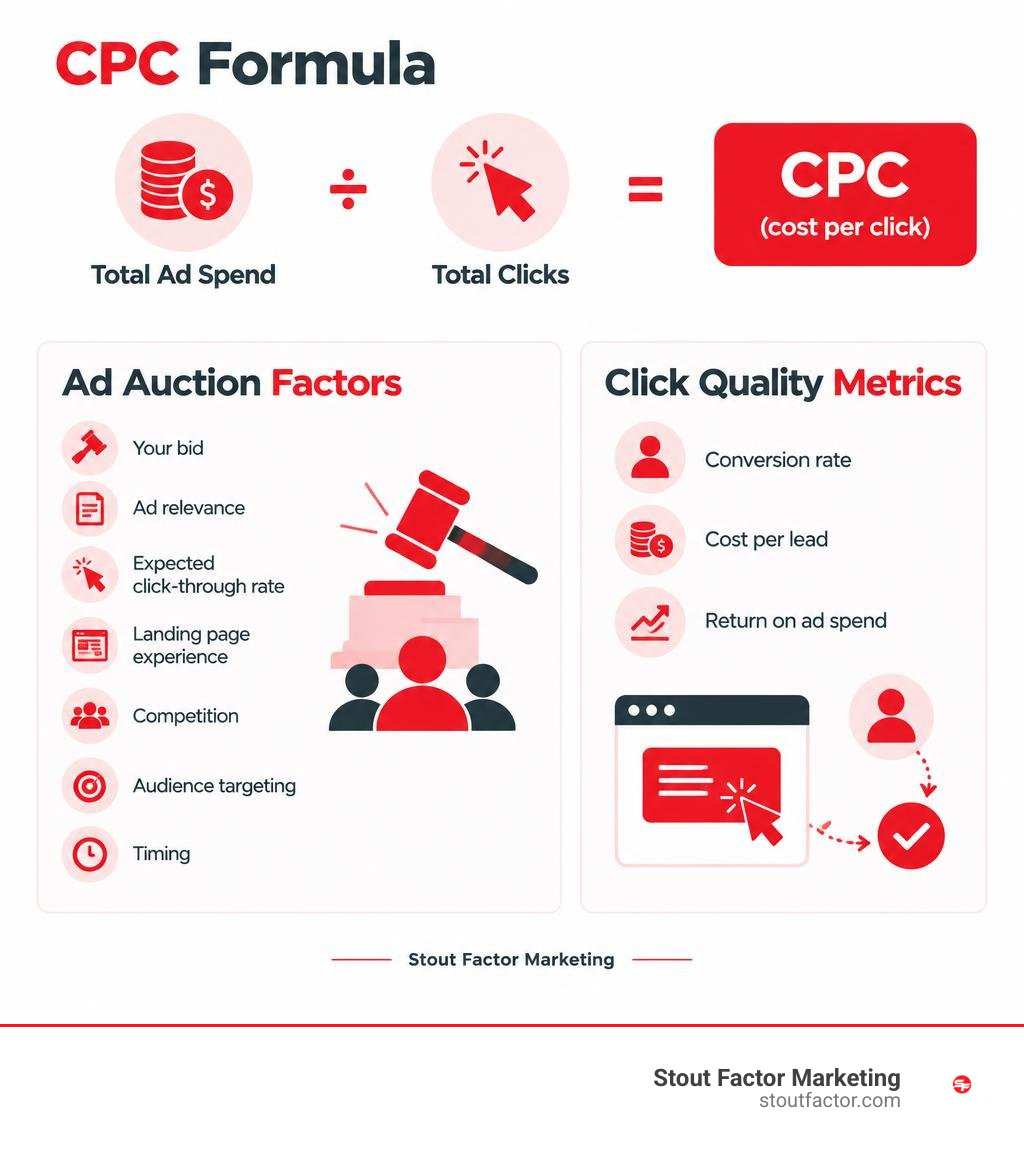
Cost per click in digital marketing (CPC) is the average amount you pay when someone clicks a paid ad. Calculate it by dividing total ad spend by total clicks. For example, if you spend $300 and receive 150 clicks, your CPC is $2.
CPC helps you control traffic costs, but a cheap click is not always a valuable one. The best CPC is one that brings qualified visitors who become leads, calls, sales, or customers. To judge it well, track CPC alongside conversion rate, cost per lead, and return on ad spend.
In most ad platforms, your final CPC is shaped by an auction. Your bid matters, but so do ad relevance, expected click-through rate, landing page experience, competition, audience targeting, and timing.
I am Krista Stout, Principal Cofounder of Stout Factor Marketing, with more than 15 years of experience building digital and multi-channel campaigns. I help businesses make sense of cost per click in digital marketing so their ad budgets produce stronger leads and better ROI.
Understanding Cost Per Click in Digital Marketing: Definition and Core Mechanics
Cost per click serves as the financial backbone of performance advertising. Unlike traditional media channels where you purchase static space regardless of interaction, digital paid search and paid social platforms operate primarily on engagement. When you launch a campaign on networks like Google Ads, Microsoft Advertising, Meta, or Amazon, you participate in an ongoing, real-time auction.
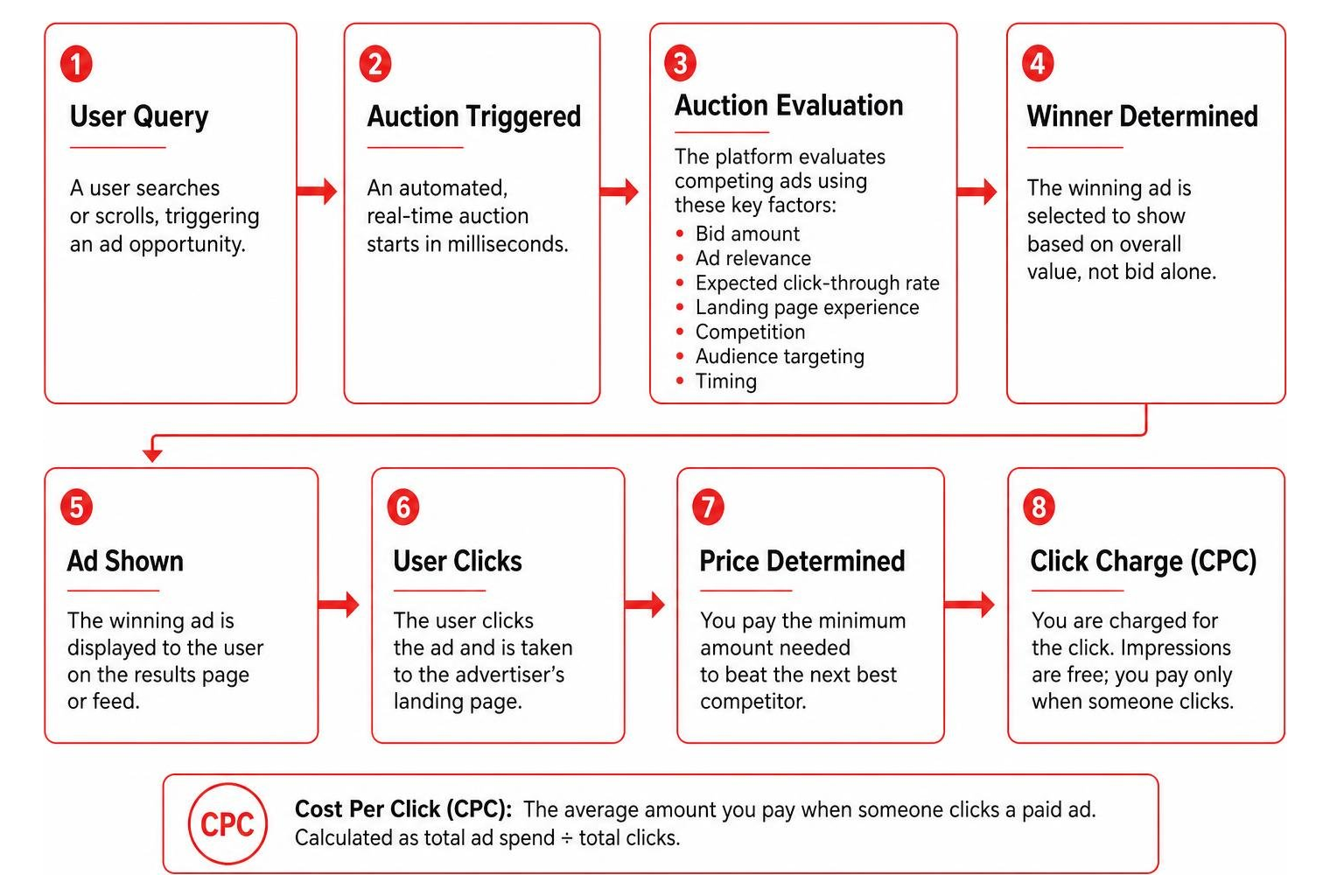
Under the standard pay-per-click framework, an impression—the mere visual display of your ad on a search engine results page or social feed—costs nothing by default. You incur a charge only when a user actively clicks on your creative asset to visit your landing page. According to Google’s official definition of cost-per-click, this billing structure guarantees that every dollar deducted from your budget directly corresponds to measurable user engagement.
However, CPC is not a fixed menu price. Every time an individual performs a search query or scrolls past an ad placement, an automated programmatic auction triggers in milliseconds. Algorithms evaluate competing advertisers based on their bids, the contextual intent of the user, past performance data, and asset relevance to determine who gets displayed and at what exact price.
CPC vs CPM, CPA, and ROAS: Choosing the Right Pricing Model
Choosing the correct advertising model depends entirely on your business objective. Digital marketing offers several pricing models, and understanding how they interact keeps you from draining ad spend on the wrong campaign goals:
- Cost Per Mille (CPM): You pay a set fee for every 1,000 impressions, regardless of whether anyone clicks. CPM is the go-to model for top-of-funnel brand awareness, video view campaigns, and wide display reach where visual exposure is the primary objective.
- Cost Per Click (CPC): You pay strictly when an action occurs (the click). This model is ideal for mid-to-bottom-funnel direct-response marketing, capturing search intent, and driving qualified traffic directly to product pages or lead-generation funnels.
- Cost Per Acquisition (CPA): You measure the exact marketing cost required to generate a specific conversion, such as a completed form submission, booked appointment, or product sale. While ad platforms often bill on underlying clicks or impressions, optimizing for CPA forces algorithms to hunt for converting users.
- Return on Ad Spend (ROAS): A revenue metric that calculates the gross revenue generated for every dollar spent on advertising ($text{ROAS} = text{Revenue} div text{Ad Spend}$).
If your goal is to build broad local awareness across outdoor, display, and social channels, impression-based buying (CPM) often makes sense. But if your goal is driving qualified buyers who are actively searching for your solutions, CPC provides the most direct balance of audience intent, traffic volume, and budget control.
How Bidding Strategies Shape Cost Per Click in Digital Marketing
The bidding strategy you select determines how much control you maintain over individual click prices versus how much decision-making power you grant to machine-learning algorithms:
- Manual CPC Bidding: You establish a rigid maximum limit on what you are willing to pay for a click on specific keywords or ad sets. This method gives you total budgetary control, preventing sudden cost spikes, but requires regular monitoring and manual adjustments.
- Maximize Clicks: An automated bid strategy designed to generate the highest possible number of clicks within your designated daily budget. It works well when building initial traffic volume or compiling retargeting pools, though it does not distinguish between high-converting and casual visitors.
- Target CPA (Cost Per Acquisition): An automated Smart Bidding strategy where the platform sets real-time bids at auction time to capture as many conversions as possible at or below your target acquisition cost. Clicks will fluctuate in price depending on the system’s confidence in the user’s intent to convert.
- Target ROAS (Return on Ad Spend): The system automatically adjusts bids to maximize conversion value rather than conversion volume. A click from a prospect likely to purchase a $2,000 package will receive a substantially higher bid than one evaluating a $20 product.
- Marketplace-Specific CPC Options: Retail platforms also provide specialized rules. For example, reviewing an Amazon Ads guide to cost-per-click highlights dynamic bidding features such as “down only” or “up and down,” which adjust keyword bids in real time based on how likely a shopper is to complete a purchase.
How Cost Per Click Is Calculated and Auction Dynamics
At its simplest accounting level, the formula to find your average cost per click is:
$$text{Average CPC} = frac{text{Total Ad Spend}}{text{Total Clicks}}$$
If your paid search campaign spends $1,200 across a 30-day billing cycle and generates 600 clicks, your average CPC is precisely $2.00.
However, your actual CPC paid during each auction rarely matches your maximum bid. Most major networks utilize a modified second-price auction mechanism. In a pure second-price auction, the highest bidder wins the ad placement, but they do not pay their maximum bid. Instead, they pay only the minimum increment necessary to outrank the Ad Rank of the competitor immediately beneath them (often as little as $0.01 more), subject to minimum reserve prices set by the platform.
| Advertising Platform / Industry | Average CPC | Typical Conversion Rate | Recommended Primary Goal |
|---|---|---|---|
| Google Ads (Search All-Industry Average) | $2.69 – $5.26 | 3.50% – 5.00% | High-Intent Lead Generation & Sales |
| Google Display Network | $0.63 | 0.50% – 1.00% | Top-of-Funnel Retargeting & Brand Reach |
| Meta Ads (Facebook Feed / Instagram) | $0.40 – $0.70 | 2.00% – 3.50% | Visual Discovery, Social Engagement & Leads |
| LinkedIn Ads | $5.58 | 2.50% – 4.00% | High-Value B2B Account Targeting |
| Amazon Ads (Sponsored Products) | $0.91 | 9.00% – 12.00% | Direct E-commerce Sales & Product Velocity |
| Legal Services (Google Search) | $6.75 – $9.21 | 4.35% | High-Ticket Client Retainers |
| Finance & Insurance (Google Search) | $3.44 – $7.86 | 5.10% | Policy Quotes & Wealth Management Leads |
The Mathematical Formula and Calculating Maximum Allowable CPC
To prevent overspending on paid media campaigns, you should calculate your break-even threshold and maximum allowable CPC before allocating advertising dollars. You can utilize a free online CPC calculator to quickly model various budget scenarios, or calculate it directly using this standard formula:
$$text{Max CPC} = text{Revenue Per Conversion} times text{Target Profit Margin} times text{Conversion Rate}$$
Let’s walk through an example for a regional service business:
- Average Revenue Per Sale: $1,500
- Target Profit Margin: 30% ($450 profit cushion per sale)
- Landing Page Conversion Rate: 4% (0.04)
$$text{Max CPC} = $1,500 times 0.30 times 0.04 = $18.00$$
In this scenario, paying up to $18.00 per click allows the campaign to hit its profitability targets. If your average CPC remains at $6.50, your paid campaigns will generate strong margins. If competitive bidding pushes your CPC above $18.00 without an improvement in conversion rate, the campaign operates at a loss.
The Role of Quality Score, Ad Rank, and Auction Mechanics
On Google Ads, having the deepest pockets does not guarantee the top ad position. Platforms protect their user experience by enforcing ad quality standards. Google calculates an Ad Rank score for every ad entering an auction:
$$text{Ad Rank} = f(text{Max CPC Bid}, text{Quality Score}, text{Ad Rank Thresholds}, text{Context of Query}, text{Asset Impact})$$
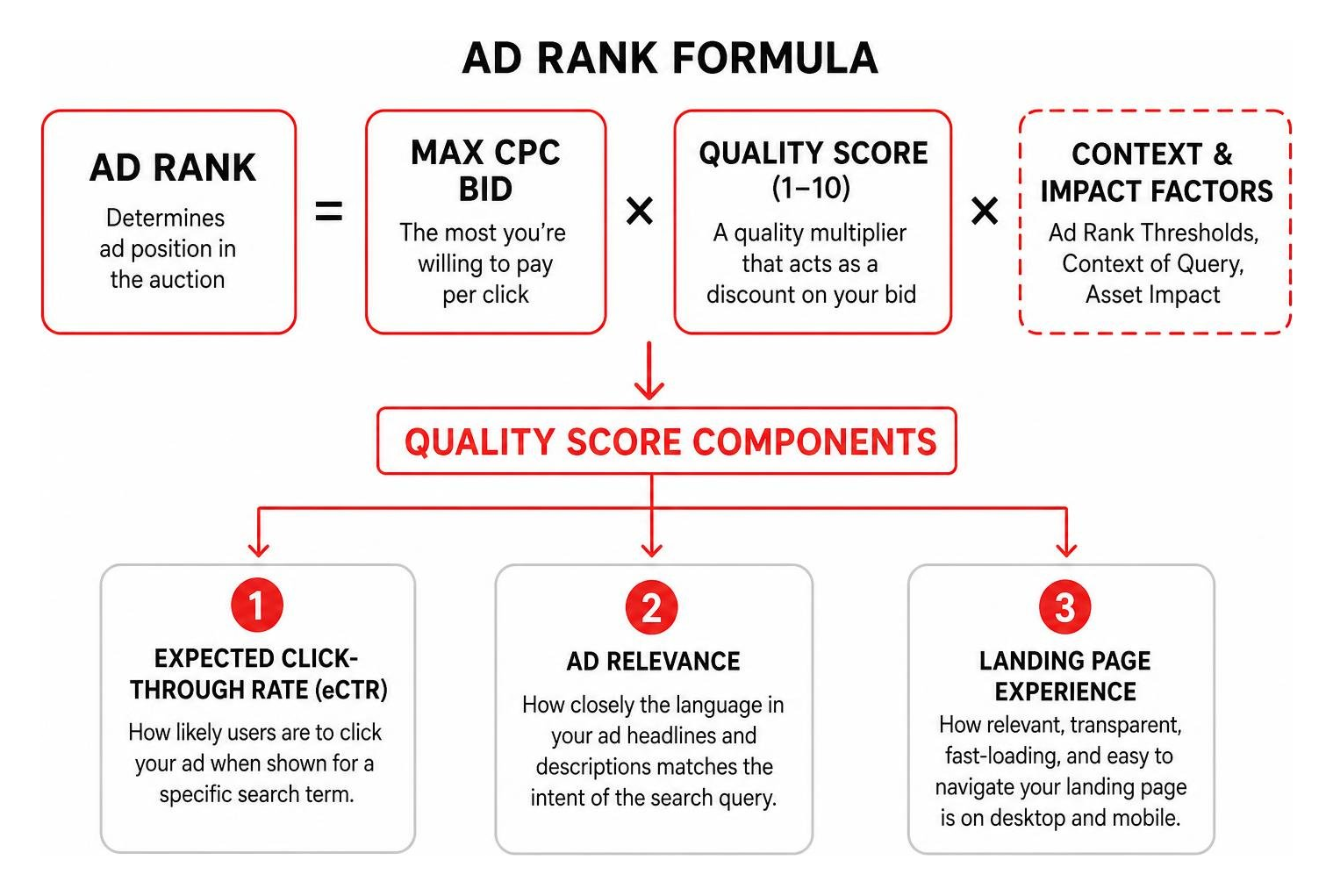
Understanding the detailed actual cost-per-click mechanics reveals that Quality Score (rated from 1 to 10) acts as a discount multiplier on your media spend. It evaluates three primary components:
- Expected Click-Through Rate (eCTR): How likely users are to click your ad when shown for a specific search term.
- Ad Relevance: How closely the language in your ad headlines and descriptions matches the intent of the search query.
- Landing Page Experience: How relevant, transparent, fast-loading, and easy to navigate your landing page is on both desktop and mobile devices.
When you raise a keyword’s Quality Score from 5/10 to 10/10, your effective CPC can drop by up to 50% for the exact same ad position. Conversely, a poor Quality Score of 2/10 penalizes your campaign, requiring you to bid up to 400% more just to maintain visibility against higher-quality competitors.
Platform and Industry Benchmarks: What Is a Good CPC?
A “good” CPC cannot be evaluated in a vacuum; it depends entirely on your industry’s economics, audience targeting, and deal size. Across Google Ads, the all-industry average cost per click reached $5.26 in 2025 (a noticeable increase from $4.66 the prior year). Meanwhile, Google Search Network averages hover around $2.69, while Google Display ads average $0.63.
Platform pricing varies widely based on targeting capabilities and user intent:
- LinkedIn Ads: At an average of $5.58 per click, LinkedIn is among the more expensive digital advertising channels. However, for B2B enterprises targeting specific job titles, seniority levels, or company sizes, the high CPC is justified by high deal values.
- Meta Ads (Facebook & Instagram): Averages range from $0.40 to $0.70 per click, making it a cost-effective platform for consumer products, lifestyle brands, and retargeting campaigns.
- Amazon Ads: With an average CPC of $0.91, Amazon sits in a sweet spot for direct e-commerce conversions because shoppers are actively browsing with credit cards in hand.
Verticals with high lifetime customer values support higher click costs. Legal services frequently command Google Search CPCs between $6.75 and $9.21 (with highly competitive personal injury terms often exceeding $50 per click). Education programs average $6.23, while Finance and Insurance campaigns range between $3.44 and $7.86. On Facebook, finance leads at $3.89 per click, internet and telecom averages $3.35, and education sits at $2.11.
Navigating Benchmarks for Cost Per Click in Digital Marketing
When evaluating your performance against broader market data, consider the underlying variables that create pricing shifts. For a detailed reference on baseline formulas and performance tracking, reviewing a guide to cost per click definitions and formulas provides useful context.
Key structural factors influencing CPC fluctuations include:
- Geographic Variations: Target location heavily dictates auction density. For example, Facebook Ads average $0.97 in the United States and Canada, compared to $0.15 in lower-competition international markets like India.
- Audience Seniority: On B2B platforms like LinkedIn, bidding on C-suite executives (CEOs, CFOs, CIOs) requires significantly higher bids than reaching entry-level employees due to heightened auction competition.
- Device Segmentation: Mobile clicks often carry different CPC rates and conversion efficiencies than desktop clicks, depending on how frictionless your checkout or mobile lead form is.
- Seasonality: During peak retail events like Q4 holiday shopping, Black Friday, and Cyber Monday, overall advertiser demand surges, causing temporary platform-wide CPC increases of 20% to 40%.
Actionable Strategies to Lower Your CPC While Protecting Lead Quality
Reducing cost per click should never mean sacrificing lead quality. If you cut your CPC in half by attracting bot traffic or unqualified visitors who immediately bounce, your overall acquisition costs increase. The goal is to eliminate wasted ad spend while maintaining strong buyer intent.

- Refine Keyword Match Types: Broad match keywords without guardrails expose your budget to loosely related search terms. Transition high-performing queries into Phrase Match and Exact Match ad groups to preserve your ad spend for bottom-funnel searches.
- Build an Aggressive Negative Keyword List: Regularly audit your Search Terms report. Flag and exclude irrelevant terms (such as “free,” “jobs,” “templates,” “DIY,” or unrelated brands) to prevent paying for clicks that will never convert.
- Target Long-Tail Keyword Variations: Broad head terms like “accounting software” carry intense competition and inflated bids. Specific long-tail phrases like “cloud accounting software for construction contractors” cost less per click and convert at significantly higher rates.
- Implement Dayparting (Ad Scheduling): Analyze conversion data by hour and day of the week. Reduce or pause bids during overnight hours or low-performing days when clicks rarely produce leads.
- Apply Geo-Targeting Adjustments: If data shows specific zip codes, cities, or counties generate higher closing rates, shift budget allocations away from underperforming regions and place bid modifiers on high-value locales.
Improving Relevance to Cut Ad Costs by Up to 50%
The most sustainable way to lower your actual CPC on search platforms is systematically improving your Quality Score. Because Ad Rank rewards relevance, aligning every asset in your campaign structure pays immediate financial dividends. Developing a cohesive strategy through strategic campaign planning ensures your creative messaging matches search intent from the first ad exposure to the final sale.
- Create Tightly Themed Ad Groups: Limit each ad group to 5 to 10 closely related keywords rather than lumping 50 varied phrases into a single ad set.
- Match Ad Copy to Query Intent: Integrate the primary search keyword directly into your Responsive Search Ad headlines and descriptions to improve expected CTR.
- Optimize Landing Page Speed and Relevance: Ensure landing pages load in under 2 seconds, are fully optimized for mobile devices, and directly reflect the specific offer promised in the ad text.
- Filter Invalid Traffic: Use native exclusion rules and automated fraud filters to avoid paying for accidental clicks, click farms, and web crawlers.
Frequently Asked Questions About Cost Per Click
What is the difference between PPC and CPC?
PPC (Pay-Per-Click) refers to the overall digital advertising model and marketing channel where advertisers pay platforms only when an ad is clicked. CPC (Cost Per Click) is the specific performance metric and financial calculation that measures the exact cost paid for each of those clicks ($text{Spend} div text{Clicks}$).
Why does actual CPC often differ from maximum CPC bid?
Your maximum CPC bid is simply the ceiling you set—the absolute most you are willing to pay for a click. Thanks to second-price auction dynamics, your actual CPC is determined dynamically at auction time. You pay only the minimum amount required to outperform the Ad Rank of the competitor immediately below you, meaning your actual charge is frequently lower than your maximum bid.
Is a low CPC always better for campaign performance?
Not necessarily. A very low CPC often indicates broad, top-of-funnel traffic, poor search intent, or low-value audience placements. A high-ticket B2B company paying $15.00 per click for a senior decision-maker with a 10% conversion rate will generate far higher profitability than paying $1.00 per click for generic visitors who never convert. Always evaluate CPC in tandem with conversion rate, Cost Per Acquisition (CPA), and overall customer lifetime value.
Conclusion
Cost per click remains one of the most vital metrics in paid digital media, serving as an early indicator of audience interest, auction competitiveness, and media efficiency. However, treating CPC as an isolated target can lead to misguided budget cuts that hurt your bottom line. Sustainable growth requires balancing competitive bidding with strict Quality Score management, high-converting landing pages, and clear full-funnel attribution.
At Stout Factor Marketing, we help growing brands craft unified marketing programs that turn paid clicks into measurable business revenue. Explore our full-service digital advertising services to build data-driven campaigns that optimize your ad spend, increase conversion quality, and maximize your return on investment.